Saturday, November 17, 2007

Shanghai VW upgrades the Santana 3000 for 2008 - 1st Pics


Here are photos which have been obtained by chinacartimes of the 2008 Shanghai Volkswagen Santana 3000 which possibly will be called Santana 4000 for 2008.


As we can see front the pictures the Santana 4000 will get rid of the pronounced V-grill VW grill in favour of a 2008MY Canadian City Golf (which is a Bora HS in China) inspired grill mixed with Tiguan styled chrome strips on higher specified models.


The rear takes cues from the former Shanghai VW / VW Brazil Santana 2000 which is what this Santana 3000/4000 is based off, the circular LED style brake lights look like they are from bigger brother within Shanghai VW, the Passat Lingyu.

Now for all those that don't know the Santana series is based off of the 'B2' Passat/Quantaum platform from the 1980s.

The Santana 2000 series was developed by VW of Brazil and Shanghai VW in the early 1990's as a cheap alternative for the companies, instead of building the new expensive 'B3' Passat of the time.

Today the Santana brand is so strong in China that it is unlikely VW will ever drop the Santana and Santana 3000 (they will continue to be upgraded).

Currently Santana 3000 which was released in 2004 comes with a 1.8L engine producing 74kw / 100hp.
Expect this engine to be carried over into the new model.

Source:http://www.chinacartimes.com/2007/10/24/santana-gp-enough-to-get-a-chinese-gent-excited

Labels: , ,

Friday, November 16, 2007

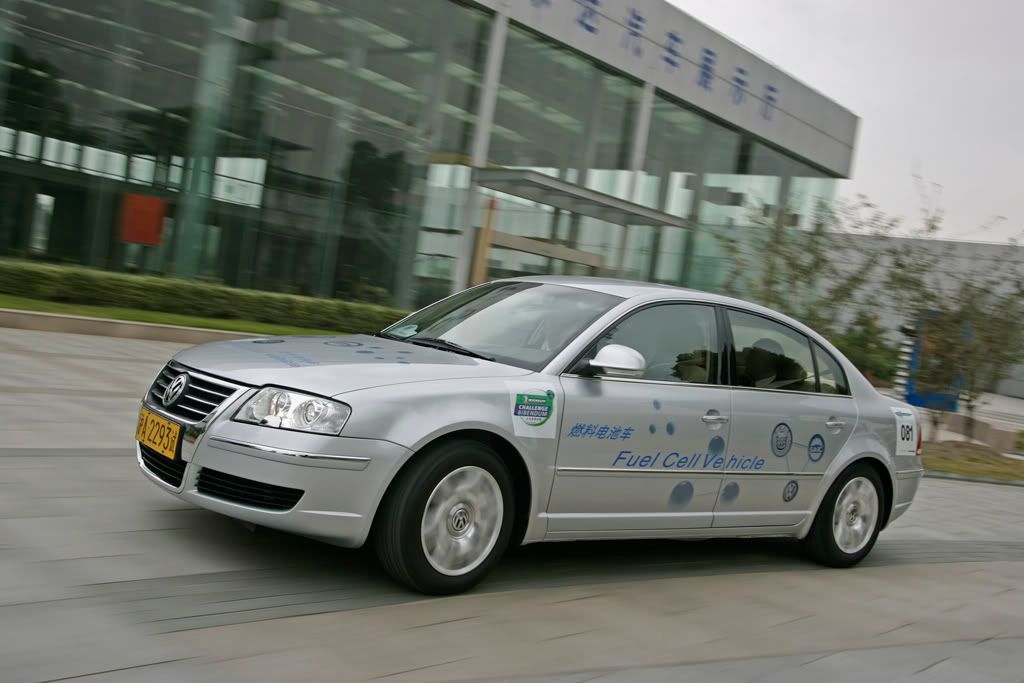
Zero Emission Passat Lingyu @ Michelin Challenge Bibendum 2007 in Shanghai


Here is a zero emission Passat powered by a Hydrogen Fuel Cell developed by Shanghai Volkswagen (SAIC and VW) and Tongji University.

Its not the first Hydrogen Fuel Cell developed by SAIC, VW and Tongji University together, since 2004 there have been 4 studies ChaoYue 1 to 4 based on Shanghai VW models.

This latest study is the most advance of them all.

more details after jump.

2007 Bibendum Challenge - Passat Lingyu with fuel cell
The car from the campus: Tongji University develops fuel cell

Zero emissions Passat was constructed by renowned Tongji University

Should set a precedent: Students, professors and industry combine forces
Wolfsburg / Shanghai, 14 November 2007

The zero emissions version of the Passat Lingyu is ahead of its time. The prototype, jointly developed by Volkswagen and Tongji University in China, is an example of

Volkswagen’s long-term collaborative work with the world’s most creative thinkers in developing new solutions for a clean future. Tongji University, which by the way was founded by Germans as a “medical school” in 1907, is one of the most respected universities in Asia today.

The fact is: The students and professors developed the Passat Lingyu to be one of the first vehicles whose fuel cell was practically entirely created at a Chinese university. An extraordinary performance. The Passat is powered by an 88 kW strong electric motor. The low-temperature fuel cell from the Tongji University supplies the energy; it is the fourth generation to be developed on the campus so far.

The hydrogen fuel cell is located in the underbody of the Passat Lingyu. The fuel cell system develops a peak power of 55 kW. The energy recovered by converting hydrogen (H2) into water (H2O) is fed into a lithium ion battery. It is located beneath the rear bench seat and has a capacity of eight Ampere-hours (Ah) at 376 Volt (V).

The gaseous hydrogen (total of 3.2 kilograms) is transferred to a carbon fiber reinforced pressure tank at 350 bar. Assuming an average consumption of about 1.36 kilograms H per 100 kilometers, the theoretical range would be 235 kilometers on one tank of fuel.

The torque-strong electric drive (210 Nm) delivers a very special and fascination. Mounted on the driven front axle, the motor provides for reasonable acceleration times (0-100 km/h: 15 s) and a top speed of 140 km/h. During faster accelerations the lithium ion battery plays a supporting role. When the Passat Lingyu is braked, on the other hand, energy flows back into the battery. It is located beneath the rear bench seat and has a capacity of eight Ampere-hours (Ah) at 376 Volt (V).


Source:Volkswagen

Labels: , , ,

Friday, November 02, 2007

VW's Mystery Sedan Spied in the Orient


We've seen pictures of VWs mysterious sedan testing in the Czech Republic earlier this year.

Now comes these fresh pictures of a sedan undergoing testing in China.

Perhaps it's the next Santana replacement or Jetta MkVI or perhaps it still is a Gol NF based sedan ?

Time will tell.....


Source: AutoScoops via auto.sohu.com

Labels: , , ,

Wednesday, July 18, 2007

China to North America VW's New Sedan


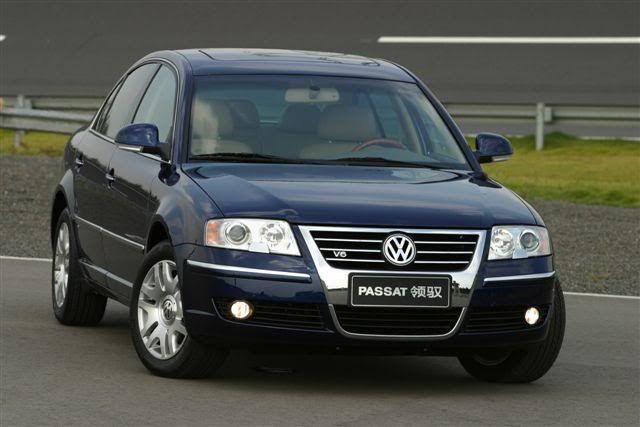
Shanghai Volkswagen Passat Lingyu

Reuters is reporting that Shanghai Volkswagen are to develop a new family sized car orientated to the Chinese and North American Markets.

The car will replace the Chinese only Passat Lingyu which is currently based on the last generation Passat albeit with 100mm longer wheelbase and comes with 1.8T and 2.8 V6 engines.

This will be Shanghai Volkswagen's First attempt at Developing a car for the Global market.

With VW and SAIC two of the biggest corporations in their own home markets, Germany and China respectively, finance $1.2 Billion will not be an issue and as such quality should be on par with the rest of the Volkswagen line-up Worldwide.

Official Shanghai VW Press Release.

July 18, 2007 - Volkswagen AG and Shanghai Volkswagen (SVW) sign a joint declaration of cooperative development for a new car model. Dr. Ulrich Hackenberg and Hubertus Lemke from VW sign the declaration with Chen Zhixin and Oeljeklaus from SVW. Also present at the signing ceremony are: SAIC Chairman Hu Maoyuan, SAIC Motor President Chen Hong, and Prof. Dr. Winterkorn, Dr. Heizman, De Silva and Dr. Vahland from VW.


As the declaration expresses, the two parties plan to cooperate in developing a new car for the North American and Chinese markets. The car will be based on a new B-platform and served as a successor to the PASSAT LINGYU model. SVW research and development shall be integrated step-by-step in the worldwide development network of Volkswagen.


SVW will develop the vehicle body, including major elements of the exterior and interior of the new car. The parties will make maximum use of SVW¡¯s test facilities, proving grounds, its prototype construction as well as parts and tools¡¯ trial manufacturing capabilities..For the first time with this project, SVW will be involved in the development of a new vehicle intended for both Chinese and global markets. The company invested about 3 Billion RMB to build up its development capabilities since starting business in 1984. The company has so far built up a technical development force composed of over 1,200 engineers and technical staff.

Shanghai Volkswagen has currently invested over $400 Million (1$ Billion Yuan) to enhance the VW current models sold in the Chinese market for Chinese tastes.


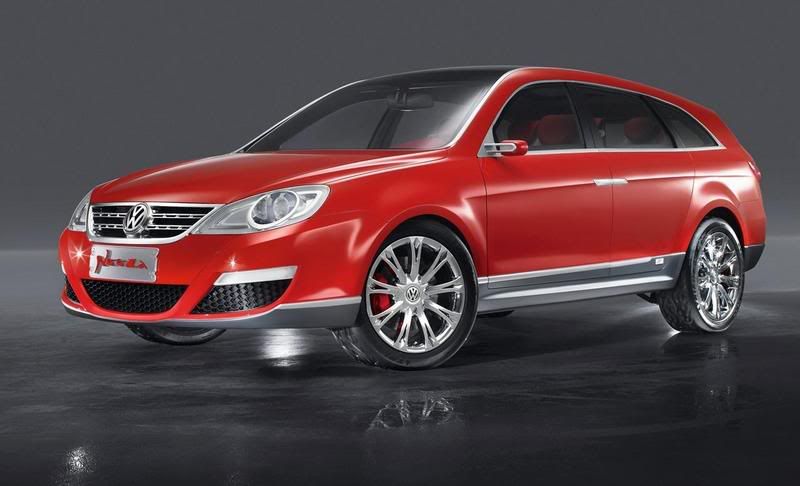
Shanghai Volkswagen designed 2006 Neeza Concept

Shanghai VW was established in 1984 building the Santana (Passat B2) which is still in production, SVW currently build the Gol, Polo, Santana, Santana 3000, Touran, Skoda Octavia and Passat Lingyu.


Source: Reuters

Labels: , , , ,